
Crewing has a long history in hot air ballooning
A BRIEF HISTORY OF CREWING
After you’ve been crewing for a few years, it’s easy to assume the way you do it is how it’s always been done. Nothing could be less true. For 225+ years, crew have quietly yet tirelessly done whatever their era has required to keep their pilots and sport alive, and that “whatever” has evolved dramatically in the past 50 years alone. Taking a larger look at where we’ve come from can offer some perspective of our heritage, how the “modern” era came about, and where the future may lie. And sometimes the only way to take a step forward is by first taking a step back.
From day one in France, nearly all flights were experimental, military, or scientific in nature. Crew for the Montgolfiers’ famous flight rode horseback and were unsure even if their passengers would be alive on landing (no one knew if there was air above the ground, much less if it could sustain life). Arriving late after a rough landing, they found the rooster with a broken beak and the sheep with an injured hoof. Peasants responded to this never-seen devil-sent creation with fear and pitchforks, and balloonists quickly established a champagne tradition to protect life and property. For the next 180 years, crew input was largely physical and pre-launch in this non-sport.
Flash forward to the 1960s when Ed Yost brought the fledgling era of sport ballooning to the masses. Absent were powered fans, crown lines, and tie-offs. “Flap” inflations (as long and physical as they sound), ground handling nightmares, and running take-offs were routine. Despite onboard liquid fuel and underpowered burners, pilots would preheat envelopes with a portable “weed wand.” Flights were loosely organized with little routine with crew focused on pre-flight physical tasks. So began the era of “chasing.”
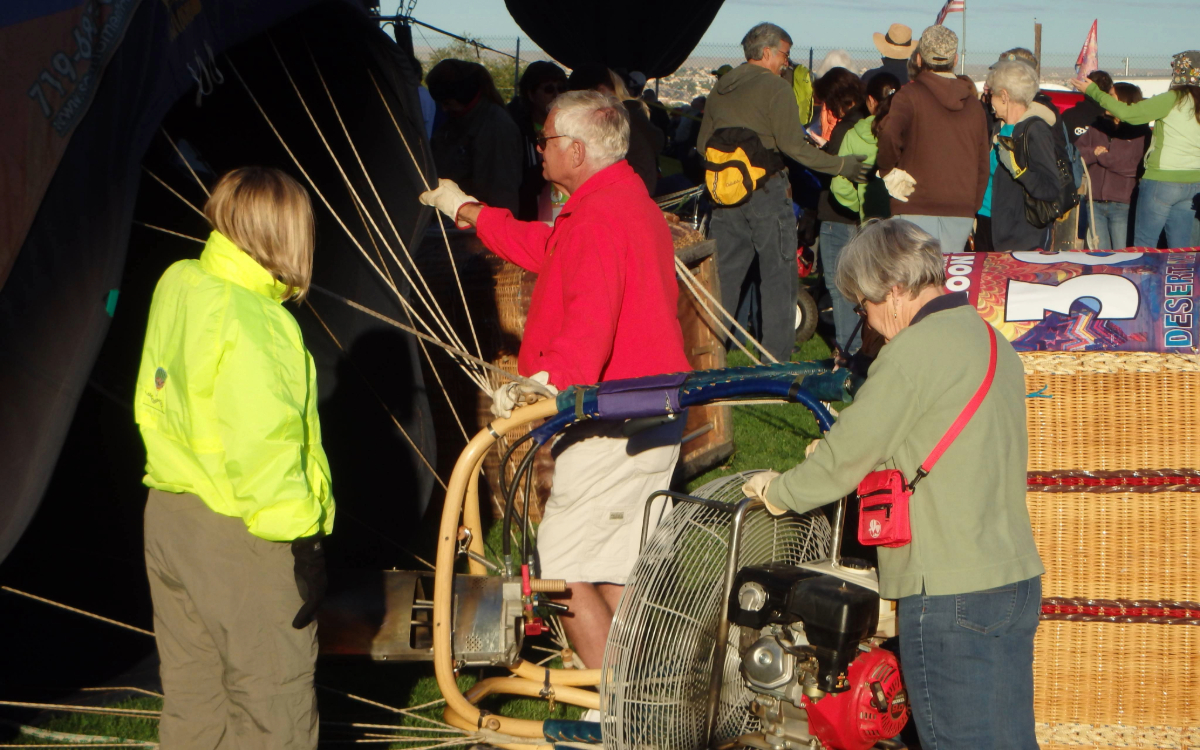
By the mid-1980s, ballooning and crewing began maturing. Powered fans and lift-gates cut out the majority of physical work required. Velcro-tabbed parachutes replaced Velcro-stripped tops, made pre-flight prep simpler and quicker, and gave pilots more handling/landing options. Tie-offs, crown lines, and tether systems brought much-needed ground control. Larger ride balloons and special shapes entered the scene. Radios made air-to-ground communication more common. Festivals with dozens or even hundreds of balloons appeared annually nationwide. No one was quite sure how many crew a flight required, and crew size began growing. Crew driving pick-ups and vans for several thousands pilots nationwide filled a still-vague but essential role in flying, and “crewing” became established as a separate identity within the “balloonist” label.
Today’s crew role has grown in reach and responsibility and even evolved toward virtual co-piloting. Sharper yet broader pre-flight, in-flight, and landing routines better define crewing roles. Passenger waivers, briefings, and weather forecasts are no longer exclusively pilot domain. Many competition or commercial crew chiefs complete set-ups, cold inflations, or even hot inflations for their pilots – and then do it all in reverse on landing. Vans, SUV’s, and RV’s house dizzying arrays of tech: cell phones with internet/camera capability, laptops with real-time weather radar, and flight tracking with onboard GPS and navigation systems. No serious competition, corporate, or ride pilot can make it without an equally committed and skilled crew chief/program manager. A century ago, flight paths were great unknowns; today’s best pilots regularly score within feet or inches from miles out or fly through invisible boxes in the sky. Corporate sponsors want media-savvy crew and logo-wrapped vans creating brand awareness to festival audiences of millions – and virtual audiences with no delay for editing. Thousands of crew – but often only one or two per flight - have helped bring pure flight to the masses; over 200,000 passengers fly safely each year in the US alone. At many times, pilot and crew roles seem indistinguishable.
A precise future of crewing isn’t clear, but trends driving its accelerating evolution are. While there’s no substitute for muscle, crew increasingly leverage brains over brawn and do more with less, more precisely, and faster. A decade ago, six crew would fight to safely ground handle a 105 in 10-12 knots; today, a skilled crew chief can routinely achieve this alone using various crown line techniques. Plotting flight paths – even without electronics – means crew can offer landing assistance to greatly enhance flight safety. Crewing in the future will require more skill and understanding of equipment, flight environment, technology, and human behavior than ever before or imagined.
Some aspects of crewing, however, have not evolved as fast or at all. Crew haven’t received federal recognition – nor should they - because we are not onboard the balloon, and that’s fine. Our sport, however, has yet to standardize or even legitimize crew roles and skills in any way. The name “chase crew” still connotes passively following during a flight rather than actively and proactively assisting. Mis-prioritized electronics - useful though not necessary - have become distracting. Balloons are not IFR aircraft, and while it’s great you know within 3’ where on earth you are, the sad fact is most crew can’t save their pilot’s/passengers’ lives when they hit the power line across the street. Crew input remains mostly pre-flight when five decades of data show 80% of accidents and injuries occur on landing where crew have no expected role or task. No more decades of wallowing; it’s time to choose a new crew role which protects passengers on landing over a cherished tradition of “chasing” behind the balloon. Sometimes letting go is the best way to get a grip.
Auto racing has successfully used this evolutionary challenge to its advantage by embracing it. Compare footage of Indy or NASCAR races from 25 years ago to those from this summer. Sure, the victory goes to the driver, but races are won or lost where? In the pits. Who’s in the pits? CREW! Both leagues have strict protocol for all crew members. Crew chiefs with numerous real-time data feeds strategize, make tactical decisions, and coordinate entire teams. Crew members have roles and tasks they specifically train for. Remote spotters guide drivers through traffic and wrecks for safety and rankings, and such messages are considered essential guidance instead of challenges to authority. Radios keep everyone on the same page. Networks film, time, and broadcast crew performance as race developments. Teams review their performances. Crews train and compete with each other between races to continually improve everyone’s game. Auto racing gets it, and the whole sport has risen by its recognition of their crews’ essential roles.
As you drive up to your launch site on your next flight, take a moment to consider where ballooning has been and how your role has evolved. You are the modern generation of a 225-year plus tradition that has helped shape our sport and world. More than 20,000 crew nationwide and 100,000 worldwide share your passion and commitment to flying. Your equipment and techniques are legacies from thousands of balloonists entrusted to you for both preservation and improvement. Your crewing contributions reach far beyond the safety, commercial, and entertainment values of your next flight; they truly touch the future. Ballooning needs your best efforts as key part of the sport to survive and thrive for the next 225 years. Neither a pilot’s certificate nor a balloon is required to make this sport better (I have neither). All it takes is the burning desire to leave something better than you found it. No contribution is too small; start thinking how you can make your crewing, flights, and this sport better!
Based on the book “Hot Air Balloon Crewing Essentials” available through the author Gordon Schwontkowski